
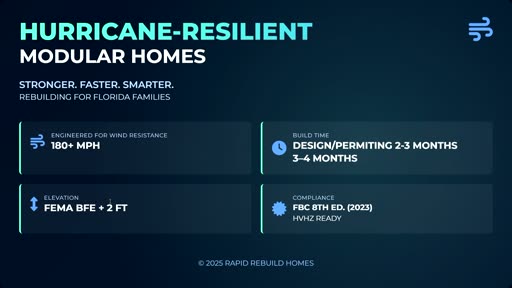
You can rebuild a hurricane-damaged coastal Florida home in roughly six to eight months with modular construction: two to three months for design and permitting, then three to four months for construction. Every module is engineered to 180 mph winds, set on deep piles up to 25 feet, and elevated above Base Flood Elevation under Florida Building Code 2023.
Watch the original webinar
This article is a written companion to a webinar I recorded for coastal Florida homeowners after Hurricanes Helene and Milton. If you would rather watch the 18-minute version, it is embedded below.
Key takeaways
- A modular coastal rebuild in Florida typically takes six to eight months from contract to keys, compared to 15 to 24 months for a traditional site-built rebuild.
- Every module is engineered to withstand 180 mph winds before it ever leaves the factory, so the home does not rely on a single jurisdiction’s minimum wind rating.
- The home sits on a deep pile foundation, up to 25 feet deep, with the finished floor elevated above Base Flood Elevation (BFE + 2 ft) to keep storm surge underneath the living space.
- Realistic all-in cost in Pinellas County runs $325 to $475 per square foot, including pile foundation, elevation, and standard finishes. Lot conditions and BFE height shift the number.
- Florida hurricane damage has climbed from roughly $50 billion (Irma, 2017) to more than $120 billion combined (Helene and Milton, 2024). Building above code is no longer optional in coastal zones.
- The Partners Contracting Group is an approved builder under Florida’s Elevate Florida program, so qualifying homeowners can pair hazard mitigation funding with a modular rebuild.
How long does a modular hurricane rebuild really take in Florida?
Roughly six to eight months from contract to keys. Design and permitting takes two to three months. Construction takes three to four months. Those phases run in parallel where possible, which is the whole point of modular delivery.
A traditional site-built rebuild in a coastal Florida county runs 15 to 24 months. You wait through weather delays, you wait on trade crews who are already stretched thin after a major storm, and you wait through on-site coordination problems that don’t exist when the home is being built in a controlled factory. Every extra month is rent, storage, commute, and insurance you keep paying.
Modular compresses that timeline because the factory build runs at the same time as site work. While our piles are going in the ground at your property, your modules are being built indoors. When the foundation is ready, the modules are trucked in and craned into place in days, not months.
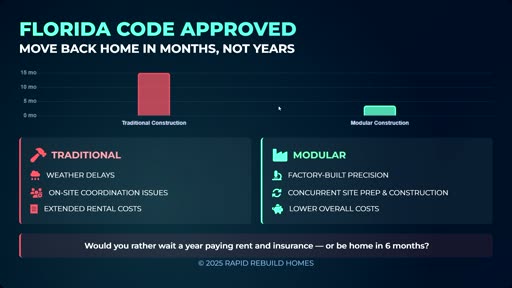
Modular versus traditional site-built: side-by-side
The full picture of why modular wins for coastal hurricane rebuilds is easier to see in a side-by-side. The table below summarizes the differences we walk every client through during their free consultation.
| Factor | Modular (Rapid Rebuild) | Traditional Site-Built Rebuild |
| Timeline (contract to keys) | 6 to 8 months | 15 to 24 months |
| All-in cost (Pinellas County) | $325 to $475 per sq ft | $375 to $600+ per sq ft |
| Wind rating engineered | 180 mph (every module) | Local code minimum (typically 140 to 170 mph) |
| Foundation | Deep piles up to 25 ft, marine-grade materials | Stem wall or slab on grade (varies) |
| Elevation | Above Base Flood Elevation + 2 ft by default | Often at existing grade unless required |
| Code path | Florida Building Code 2023 + factory special inspection | Florida Building Code 2023 + local inspections |
| Weather delays | None during factory build | Significant during Florida rainy season |
| Quality control | Factory QC + third-party special inspection + local AHJ | Local AHJ inspections only |
| Labor and material efficiency | Roughly 30% savings versus traditional | Baseline |
| Customization | Pre-engineered modules tailored to your plan | Fully custom (longer schedule and higher cost) |
| Carrying costs while you wait | 6 to 8 months of rent and storage | 15 to 24 months of rent and storage |
What makes a modular home hurricane resilient at 180 mph?
The 180 mph wind rating is engineered into every module before it leaves the factory. That is well above the Florida Building Code 2023 minimums for most of the state and matches the structural wind standards used in Florida’s High-Velocity Hurricane Zone (HVHZ) in Miami-Dade and Broward counties, even though Pinellas County is not classified as HVHZ. The reason we engineer for the upper end is simple. The module has to survive a trip of hundreds of miles over the road, get craned into place, and then live in a hurricane zone for the next 50 years. The engineering baseline has to clear all three.
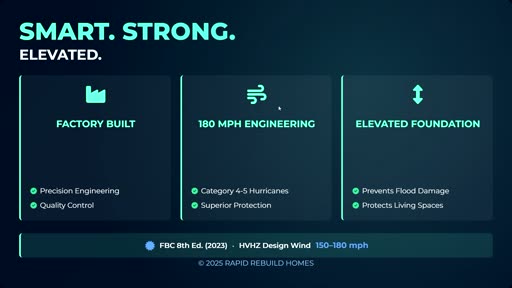
Inside the home, every structural connection is engineered for that 180 mph rating. The walls, roof, and floor systems are tied together with high-capacity connectors, not generic toenailing. The windows and doors are impact-rated glass, which works like bulletproof glass: two layers of glass with a rubbery interlayer that lets the pane crack without letting wind or debris into the structure. No shutters, no plywood, no climbing a 30-foot ladder the day before landfall.
Underneath, the foundation does the rest of the work.
Why does elevation above Base Flood Elevation matter?
Base Flood Elevation, or BFE, is the height to which floodwater is expected to rise during a base flood event in your specific location. FEMA publishes BFE by parcel on Flood Insurance Rate Maps, and your number depends on your zone, your street, and your distance from the water. Florida Building Code 2023 typically requires the lowest finished floor to sit at least two feet above BFE. That two-foot buffer is called the Design Flood Elevation.
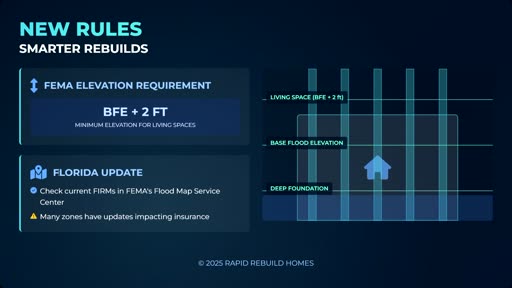
“Storm surge passes underneath the structure instead of through it.”
We build to the Design Flood Elevation by default. The deep pile foundation goes down up to 25 feet as needed for the soil conditions. From that point, one continuous structural member runs all the way up to the underside of the living space. Marine-grade materials handle the saltwater exposure. The first horizontal structural members of the home sit above BFE. The house sits on top of that.
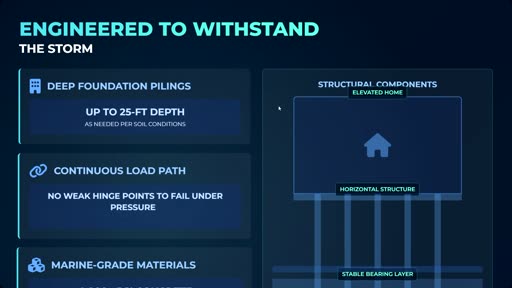
The space underneath gets used too. Some homeowners park vehicles, jet skis, or boats there. Others build out outdoor living areas. The walls that enclose that space are breakaway walls, which are designed to detach in a flood without damaging the structural piles. Flood vents in those walls let water flow in and back out without trapping pressure. The structure above stays intact.
How does modular construction stay Florida Building Code compliant?
Florida Building Code compliance is engineered into the modules from the start, not retrofitted at the site. Every module is designed to be installed in Florida from day one. The structural calculations, the wind load math, the connector schedules, the flood elevation, the impact glazing, all of it is built into the factory drawings before a single board gets cut.
A special inspection facility visits the factory throughout the build and verifies that the work matches the engineered drawings. That is a third-party inspection on top of the factory’s own quality control. By the time the modules arrive at your property, they have already cleared more inspections than a typical site-built house clears during its entire construction.
Once the modules are set, the local building department inspects the foundation, the module connections, the utility tie-ins, and the finish work. The result is a home that meets or exceeds Florida Building Code 2023 and is built to the same residential code as any site-built home in the state.
Modular is a delivery method, not a different code path. That is the part most people get wrong.
What does a coastal modular rebuild actually cost in Pinellas County?
Realistic all-in pricing for a coastal modular rebuild in Pinellas County runs $325 to $475 per square foot. That number includes the modular home, the pile foundation, elevation above Base Flood Elevation, impact glass, standard finish package, and permit costs. A 2,000 square foot home lands in the $650,000 to $950,000 range. Lot conditions, BFE height, and finish upgrades shift that number up or down.
What is not included in that range:
- The lot itself (most clients already own)
- Demolition of the existing damaged structure
- Specialty site work like seawall repair, dock replacement, or substantial drainage
- Utility line relocations beyond standard
- Premium finishes or designer upgrades beyond the standard package
Comparable site-built coastal Florida custom homes in this market typically run $375 to $600+ per square foot all-in. The factory build saves roughly 30 percent on labor and materials, but most of that savings shows up as schedule compression rather than a sticker-price discount. The bigger savings is the time you do not spend paying for two housing situations at once.
The cost of waiting: what a 15-month rebuild costs you in carrying costs alone
If you take an extra nine to 18 months to rebuild traditionally, you pay rent, storage, additional commute costs, and insurance on a property you cannot live in. The math is brutal once you write it down.
| Carrying cost | Pinellas County range | 15-month traditional | 6-month modular |
| Temporary housing (rent) | $2,500 to $4,000 / month | $37,500 to $60,000 | $15,000 to $24,000 |
| Storage of belongings | $200 to $400 / month | $3,000 to $6,000 | $1,200 to $2,400 |
| Insurance on vacant lot or damaged structure | Varies, typically $150 to $400 / month | $2,250 to $6,000 | $900 to $2,400 |
| Total carrying cost | $42,750 to $72,000 | $17,100 to $28,800 |
The carrying-cost gap alone can be $25,000 to $43,000. That is real cash that comes out of your pocket while you wait, on top of the build itself. A modular rebuild stops that bleed nine months sooner.
How does the 6-step Rapid Rebuild process work?
From the first phone call to the day you walk through the front door, the process moves through six clear stages.
- Free consultation and lot review. We meet, look at your property, review your survey and any existing plans, and check what your lot allows under Pinellas County and Florida Building Code rules.
- Design and module selection. We pick a base floor plan and customize it to your family, your view orientation, and your lot constraints. You see renderings and a finish package before any permit work begins.
- Permitting (2 to 3 months). We file with the local Authority Having Jurisdiction, coordinate the engineered drawings, and clear FEMA elevation and flood vent requirements.
- Foundation and factory build (concurrent). Pile driving and site prep happen at your property while the modules are being built indoors at the factory. This is the parallel-track step that compresses the timeline.
- Module delivery and set (1 to 2 weeks). Modules ship over the road, are craned into place on the foundation, and are tied together with engineered connectors. The home goes from open foundation to dried-in shell in days.
- Finish-out and final inspections (1 to 2 months). Utility tie-ins, finish work, final building department inspections, Certificate of Occupancy. You get keys.
Repetitive damage is not a question of if. It is a question of when the next storm hits.
How customizable are modular hurricane-resilient homes?
Modular does not mean cookie-cutter. Because every module is independently engineered for the 180 mph wind rating, we can rearrange and combine them in a lot of different configurations without breaking the structural model.
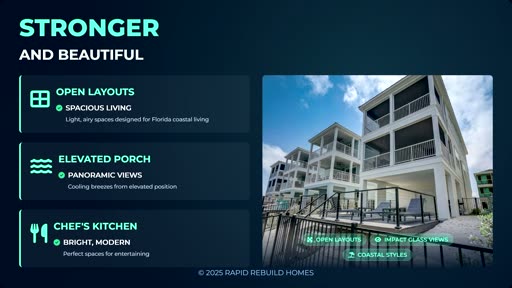
We can put a master suite on the first floor with guest suites above. We can do an in-law suite. We can add entertainment spaces like a media room or a cigar room. We can flip the layout so the primary living spaces face the sunset over the water. We can do a second-floor master with elevated porches for the view. We can pre-frame the floor for a future elevator so you do not have to cut into structure later.
We can also work the other direction. If you already have plans drawn with an architect, we can modularize them. We have done that for many of our coastal homeowners, and several of our standard floor plans started as one customer’s custom design before we adapted them into a reusable module set.
What FEMA and Florida programs do modular rebuilds qualify for?
Every home we deliver is FEMA compliant. That is engineered in from the foundation up, because most of our work is in flood zones and we know what is required.
The Partners Contracting Group has been selected by the Florida Department of Emergency Management as one of the approved local contractors delivering new homes under the Elevate Florida program. Elevate Florida is a hazard mitigation program that helps fund the cost of elevating or rebuilding flood-prone homes above Base Flood Elevation. If your property qualifies, you may be able to pair Elevate Florida funding with a modular elevated rebuild and get a stronger home for less out of pocket.
If you were not selected for Elevate Florida, the same engineering and the same timeline are still available through a private build. The program funding changes the financing, not the home.
Case study: Summer Price, Clearwater, rebuilt in 3 to 4 months

Summer Price lost her Clearwater home to Hurricane Helene. Four feet of water inside the house. Two months later her husband passed away. Inside a six-to-eight month window, she lost almost everything she had built her life around, and she was trying to figure out how to rebuild for herself and her two sons.
A few days after her husband passed, she opened Google and typed in stilt home builders. That search led her to The Partners Contracting Group.

What she found was the answer she had not had for a long time: a path to a fully elevated, 180 mph engineered modular home, delivered in three to four months instead of the 18-to-24-month rebuild cycle her neighbors were facing. In her own words:
“To have no hope for about a good six or eight months and then to see that he could do a rapid rebuild project in three to four months for us was just the answer that we hadn’t had for a really long time.” Summer Price, Clearwater, FL
What she skipped: the 18 to 24 month rebuild cycle, over a year of rental and storage costs, and the second-loss risk of rebuilding the same home in the same way. What she gained: a code-compliant home engineered for the next storm, delivered in time to take her boys home before the next hurricane season.
“They’ve just really given me hope, you know, to take me and my boys home to a new home for us and just see what the future holds.” Summer Price, Clearwater, FL
So what should you do next?
Storm season does not wait. Florida hurricane damage has climbed from roughly $50 billion in 2017 (Irma) to $25 billion in 2018 (Michael) to $113 billion in 2022 (Ian) to more than $120 billion combined in 2024 (Helene and Milton). The trend is up. The construction window between storms is narrow.
If you have already been hit once, the risk math says you will be hit again. The question is whether the next storm finds you in a home engineered to handle it, or in a home that has the same weak points as the one you just lost.
If you want to talk through what a modular rebuild looks like on your specific lot, book a free consultation with us. We will walk through what your property allows, what your timeline looks like, and whether the Rapid Rebuild program is a fit for your family. No pressure. We just need enough information to design a package that actually fits you.
Are you ready to rebuild stronger?
Jordan Bull is the owner of The Partners Contracting Group, a Florida-licensed Certified General Contractor (CGC) firm specializing in coastal modular and elevated residential construction in Pinellas County and the Tampa Bay region. The Partners Contracting Group is an approved builder under the Florida Department of Emergency Management’s Elevate Florida program and partners with FEMA on hazard mitigation rebuilds.
Frequently Asked Questions
How long does a modular hurricane rebuild really take in Florida?
Roughly six to eight months from contract to keys. Design and permitting takes two to three months. Construction takes three to four months. A traditional site-built rebuild in a coastal Florida county runs 15 to 24 months. Modular compresses the timeline because the factory build runs at the same time as site work.
What makes a modular home hurricane resilient at 180 mph?
The 180 mph wind rating is engineered into every module before it leaves the factory. Every structural connection is engineered for that rating, with high-capacity connectors rather than generic toenailing. Windows and doors are impact-rated glass. The foundation uses deep piles up to 25 feet, with marine-grade materials, elevating the finished floor above Base Flood Elevation.
Why does elevation above Base Flood Elevation matter?
Base Flood Elevation (BFE) is the height to which floodwater is expected to rise during a base flood event. Florida Building Code 2023 typically requires the lowest finished floor to sit at least two feet above BFE. This is the Design Flood Elevation. TPC builds to the Design Flood Elevation by default, with a deep pile foundation up to 25 feet so storm surge passes underneath the structure instead of through it.
How does modular construction stay Florida Building Code compliant?
Florida Building Code compliance is engineered into the modules from the start. The structural calculations, wind load math, connector schedules, flood elevation, and impact glazing are built into the factory drawings before construction begins. A special inspection facility verifies the work matches the engineered drawings throughout the factory build, on top of the factory’s own QC. Once the modules arrive on site, the local building department inspects the foundation, module connections, utility tie-ins, and finish work.
What does a coastal modular rebuild actually cost in Pinellas County?
Realistic all-in pricing for a coastal modular rebuild in Pinellas County runs $325 to $475 per square foot. That includes the modular home, pile foundation, elevation above Base Flood Elevation, impact glass, standard finish package, and permit costs. A 2,000 square foot home lands in the $650,000 to $950,000 range. Comparable site-built coastal Florida custom homes typically run $375 to $600+ per square foot.
How does the six-step Rapid Rebuild process work?
Step 1: Free consultation and lot review. Step 2: Design and module selection. Step 3: Permitting, which takes two to three months. Step 4: Foundation and factory build, which run concurrently. Step 5: Module delivery and set, which takes one to two weeks. Step 6: Finish-out and final inspections, which take one to two months and end with the Certificate of Occupancy.
How customizable are modular hurricane-resilient homes?
Because every module is independently engineered for the 180 mph wind rating, modules can be rearranged and combined in many different configurations without breaking the structural model. Options include first-floor master suites, in-law suites, second-floor masters with elevated porches, pre-framed floors for a future elevator, and modularization of customer-supplied architectural plans.
What FEMA and Florida programs do modular rebuilds qualify for?
Every home is FEMA compliant. The Partners Contracting Group is an approved builder under the Florida Department of Emergency Management’s Elevate Florida hazard mitigation program. Qualifying homeowners may be able to pair Elevate Florida funding with a modular elevated rebuild. Homeowners not selected for Elevate Florida can still access the same engineering and timeline through a private build.